ETHEREAL DIALOGUE BLOG
This blog explains the raw, personal journey behind my mission to pursue radical self-improvement and why I created Ethereal Dialogue to share hard-won insights with no agenda.
Chronological Order
Introduction: The Uncommon Path
The decision to create this blog stems from a realization that my life's path—especially the profound internal discoveries—has been unique. My hope is that by sharing these experiences, I can offer new perspectives to those on their own journey of growth. This space, Ethereal Dialogue, is dedicated to the lifelong pursuit of a better self.
The Seed of Purpose
I recall a conversation from my early youth (around age 14 or 15) that remains uniquely clear in my memory. When I was asked, "What is your purpose in life?" my answer was immediate and certain: "I want to be better than I was yesterday."
It’s remarkable that this single moment stands out, as I don't retain many memories from that time. That simple, unwavering purpose set the trajectory for my entire life, and even after all these years, the commitment to self-improvement remains.
Gaining Self-Authority and Pushing Boundaries
My journey truly accelerated at the age of 18, when I first experienced radical self-authority. Moving eight hours away from my parents and establishing my own living space was a pivotal moment. This autonomy allowed me to test and push the boundaries of what I believed I was capable of, challenging the perceptions I had held up to that point.
During my university years, I was constantly seeking environments and relationships that mirrored my internal progress, causing me to relocate countless times over seven years.
The Challenge of Internal Change
While some changes are tangible, expanding our understanding of psychology (the inner landscape of mindset, emotion, and self-awareness) and philosophy/ideology (the belief systems and frameworks we use to govern our actions) often hits us more deeply. They challenge the very core of who we believe we are.
I remember dedicating years to intensely studying and working on my ego—within the bounds of my understanding at the time. This internal confrontation required me to be profoundly open to outside sources of knowledge, often hitting me in the heart before my logic caught up.
The Burden of Inheritance and Misplaced Guilt
This internal work was often complicated by my inheritance: my father's stories. He often recounted his own struggle, having left Turkey at the age of 15 to work in Germany, eventually returning with enough capital to become a well established factory partner. Yet, the deepest scars came from my grandparents, who survived World War II, including fleeing Romania to Turkey and my grandfather finding the means to live through intense scarcity.
My father's survival experiences taught him the ultimate lesson of lack, which made him guarded. This, combined with an early lesson in global poverty, burdened me with guilt over my own comfortable life. I began seeking out difficult situations to test my limits—to see "how much I could endure.
The High Cost of Misunderstood Humility
My desire to embrace humility caused me to minimize my own worth, and in doing so, I found myself repeatedly deemed unworthy of respect or effort. I learned a devastating lesson: while I genuinely valued truth, honesty, and kindness, I was repeatedly met with rejection and disrespect. People dismissed my valid concerns and even rejected me while I was actively protecting them.
It wasn't until the age of 40 that the final, painful truth clicked: Most people fundamentally prioritize their own immediate comfort and personal gain; they do not prioritize truth, honesty, or equality. This realization shattered my perception, and everything began to shift.
The Breakthrough and The Sacred Vow
My journey had already brought me to Canada in 2008, where the lack of firm boundaries meant people constantly tested and abused me, leading to my first panic attacks. Unable to bear the city, I moved to Victoria, BC, where my dream of an nomad life crashed when someone recoiled simply after learning I lived in my car—a moment I realized the judgment I faced was not about my character but about my perceived social status.
After years of loss, lies, accusations, and abuse, I finally made a sacred vow: I am the most important person in my life. I stopped expecting protection from others and took responsibility for protecting myself.
The shift was powered by immersion: I started meditating and listening to teachers like Abraham Hicks and Dr. Joe Dispenza constantly. I saturated myself with affirmations until a new self arose. I finally felt free from the burden of my past, accepting things as they are, and viewing mistreatment not as a reflection of my worth, but as the other person's developmental stage.
Conclusion: A Pledge of Support
This freedom was hard-won. I gained this freedom 'by nail and bone.'
While my journey involved professional support, the majority of the human interactions that shaped my day-to-day life were transactional. My greatest desire during those years was for consistent, pure support during my journey toward self-sovereignty.
Now, having paid the price of this freedom by nail and bone, I offer that support to you. I am here to share the lessons and illuminate the ground beneath your steps, not to guide them. This journey of radical self-creation is yours alone, and I invite you to step into Ethereal Dialogue and reclaim the most important person in your life: you. This is your path. Hold on tight to it, and know that you no longer walk it in silence.
To those individuals who entered my life, even for a brief moment, and acted with truly pure intentions: Thank you! Your kindness was a necessary light in the darkness.
✨ The Journey Starts Here: Why I Created This Blog
Comments
The Alchemist Within: Why Chaos is Not Condemnation
It is a common human burden to live under the heavy misunderstanding that life’s harsh conditions—the negativity, the disappointments, and the sudden storms—are a verdict on one’s worth. Many are taught to view "Karma" as a cosmic sentence or a receipt for past mistakes, but living in this state of mind makes life feel less like a journey and more like a punishment. Because certain doctrines and systems of thought thrive on this guilt to maintain control, it becomes necessary to eventually drop that weight in favor of a higher truth.
This is because the environments we find ourselves in are rarely about what we deserve, but are instead the specific conditions required to trigger the next stage of our evolution. Thus, the chaos we experience is not a sign of failure; it is the raw material needed to become the Alchemist. While the world tirelessly chases the fleeting high of "happiness," a more profound state exists beneath the surface: Deep Peace. This is a contentment that stands entirely apart from guilt, hurt, or mistrust, and it is found only when the search for external validation ends and the internal shift begins.
Consequently, this peace arrives the moment one realizes that the only person who can truly protect, respect, and accept the self is the self. That is why the evolution of the "Observer"—that core of being that remains unchanged while the outer character matures—is the most vital work we can do. Therefore, every disappointment must be viewed not as a setback, but as a refinement process. We are not being punished by life; we are being brought closer to our true essence. When a life is built from this internal wellspring, it becomes clear that everything is happening for the individual, not to them.
When a life is built from this internal wellspring, it becomes clear that everything is happening for the individual, not to them. Because words can only carry us so far, the video below translates this frequency into movement and light. It is for those who absorb life through the visual pulse—a reminder that your worth is never at the mercy of your conditions:
https://www.youtube.com/watch?v=LbtmIHUcVyA
"This chaos is not condemnation. You are worthy of all that you desire. Your power is not found in controlling the storm, but in becoming utterly yourself. Every disappointment was simply a step toward emotional maturity. You aren't being punished; you are being refined. You are building something within that the world cannot take away."

This journey of rendering reality doesn’t stop with words. It is woven into the silk and built into the structures of everything I create at Gaia Art Hub. If you feel a connection to this philosophy, I invite you to browse my current collections—where these reflections take their physical form. https://www.contrado.ca/stores/gaia-art-hub
If these words resonate with you, I invite you to subscribe to Ethereal Dialogue. There, I share more brief reflections on the intersection of art, reality, and the courage it takes to render our own lives.
Comments
Have you ever felt that your own truth was "too much" for the world around you?
For years, I lived in the shadow of perfectionism—an exhausting search for a reality that others would find acceptable. I was afraid that if I truly exposed myself through my art, the "chaos" of my past would be too loud. When I shared my unfiltered emotions, I often met a wall. People didn't want to relate, not because the emotions weren't real, but because they couldn't find a connection to my truth. Instead of seeing that as their limitation, I took it to heart and became afraid to express myself.
It is a common trap to look for acceptance from others as a prerequisite for accepting one's own being. Yet, in time, it becomes clear that even the harshest encounters are actually great teachers in the pursuit of inner peace. They serve as a push to stop looking outside for a permission slip that is never going to come.
The Nomad Studio
During my nomad years, the lack of a "safe space" to create while living in a tiny vehicle felt like a terminal block. Yet, looking back at that time, there was a dedication I didn't recognize till 2025. Even when I didn't feel like an artist I was still collecting natural materials from every landscape I crossed, still drawing in Timmy's and McDonald’s at midnight, local coffee shops and libraries during the day... I was gathering the seeds of what Gaia Art Hub would eventually become.
About eight or nine years ago, this impulse took a different form: installations in the woods of Vancouver Island. Built in the wild using only what the Earth provided, these pieces were designed to never harm the environment. They were eventually reclaimed by the harsh weather, vanishing as intended. At the time, this was a practice in the art of "letting go" during a period of immense personal loss.
Is there a title or a label you are fighting that is actually keeping you from your own power?
There is a profound realization that comes when we look at our own history: perfectionism is often an illusion. If it were true, a sketchbook would never be opened in a crowded store, and a sculpture would never be built on a windy beach. A perfectionist waits for the perfect conditions; a creator simply creates.
In reality, "perfectionism" is often just a fancy name for self-protection. It is a shield used to guard the soul during times of total vulnerability. During those years, the title of "Artist" felt too "puffed," too heavy with social expectations. It was a time of rebellion against any constriction of what a creator "should" be.
(Here I invite you to take a moment to name titles and labels you are fighting which keep you from your own power.)
How will you choose to render it today?
By the time one reaches their 40s, a different truth emerges: Reality is not something to be "found"—it is something that must be rendered. To search for a "found" reality is to remain at the mercy of other people or the "harsh weather." To "render" is to take the raw, painful data—for me these are the loss, the nomad life, the rejection—and decide exactly what the final image looks like.
The search is over; the creation has begun. Memories and loss are the raw materials being turned into a life worth living. Today, at Gaia Art Hub, the work still involves things that disappear, but it also takes the lessons of the woods and the vulnerability of the van and turns them into something that lasts. Truth is being rendered into silk and bone, and it is being done without apology. How about you? As you look at the pieces of your own history—the raw, the broken, and the beautiful—what memory do you want to transform?
I invite you to experience a quick spark of inspiration from my Ethereal Dialogue YouTube channel. It’s just a few seconds long, but these words serve as the heartbeat of everything I wrote here.
"Your reality is not found, it's rendered. Render it without apology!" https://youtu.be/1jmNWqBtdoM
Rendering Without Apology: From the Woods of Vancouver Island to Silk and Bone

If these words resonate with you, I invite you to subscribe to Ethereal Dialogue. There, I share more brief reflections on the intersection of art, reality, and the courage it takes to render our own lives.
This journey of rendering reality doesn’t stop with words. It is woven into the silk and built into the structures of everything I create at Gaia Art Hub. If you feel a connection to this philosophy, I invite you to browse my current collections—where these reflections take their physical form. https://www.contrado.ca/stores/gaia-art-hub
Comments
In the landscape of human relationships, there is a profound distinction between actions born of passion and those born of a desperate need for control. We often believe that by managing our circumstances or anticipating the moves of others, we are securing our safety. However, the "fact" of the matter is that controlling behavior—typically rooted in a deep-seated fear of loss—functions as a low-vibration trap. It does not protect the individual; instead, it closes the heart and tethers the mind to a cycle of perpetual worry.
The Anatomy of the Loop
To understand this cycle, one must recognize that controlling behavior is often a "cry for help" from an environment where one feels powerless. In such a state, the individual becomes hyper-focused on the other party, attempting to "play the game" to win back respect or kindness. Yet, this very engagement creates a low-vibration environment. By reacting to a "user," we inadvertently match their frequency.
For many, the realization comes not through a gentle shift, but through a shattering moment of clarity. Seeing the truth written in black and white—the cold admission that one’s kindness was being treated merely as a resource to be used—changes the internal landscape forever. It reveals a hard truth: some individuals do not act out of temporary confusion, but out of a fixed character. While we are told that changing our internal energy can shift our relationships, we must accept the fact that this does not mean we can change who people are. Their tactics may become more subtle, but their intent remains.
The Cost of the "Closed Heart"
Living in a state of constant reaction has a tangible cost. It results in a mind occupied not with one’s own life, but with the defense against another's. This hyper-vigilance changes how the world perceives us; when we are consumed by the "lures" of manipulative games, we stop radiating a love for life and start radiating tension. This is the ultimate cost of underestimating the intentionality of a "user": we become strangers to our own joy.
The path out of this loop is rarely a quick exit; it is a long process of "social surgery" and recalibration. It may require a year of "The Great Alone"—a period of minimal interaction where the external noise is silenced so the internal voice can be rebuilt. During this time, the grief we feel should not be confused with love. It is often a "sunk cost" grief—a mourning of the time and energy invested in a person who was never an equal match. A healthy sense of self-respect dictates that once harm is identified as a strategy, love must naturally cease to exist.
The Observer’s Peace
Emerging from this reconstruction, the individual moves from a state of "absorbing" energy to "observing" it. This new version of the self can read the "vibration" of a room from meters away. This discernment is vital because tests will continue to appear, often in the form of "subtle contradictions."
For instance, one may encounter a "supporter" who encourages high self-value in theory, but attempts to negotiate it away in practice—offering unequal trades for one's soul-work or art. In the past, this might have triggered an explanation or a defensive plea for respect. Today, the high-vibration response is simply indifference. A boundary does not always require a confrontation; often, it is most effectively expressed through a quiet withdrawal of presence and a refusal to engage in the game.
Conclusion: The Guarded Garden
The final fact of liberation is that high boundaries do not create a cold heart; they create a safe one. For a long time, the fear of being "unprotected" kept the heart closed, but through the process of reclaiming one's life, a new truth emerges: you can only be truly open when you are the one who holds the key to the gate. By narrowing the entrance to our inner world, we ensure that our energy is no longer a public space for "users" to trample, but a sanctuary for those who resonate with a frequency of transparency and mutual respect.
Choosing oneself is not an act of war against the "users" of the past; it is a quiet, permanent act of peace for the future. The "cry for help" that once defined our interactions is finally silenced, not because someone else answered it, but because we became our own source of rescue. We learn that we do not need to explain our silence to those who were never listening, nor do we need to justify our value to those who only sought to diminish it.
As we move forward, we carry the "Master Key" of our experiences. We no longer look at the world through the fog of worry or the exhaustion of hyper-vigilance. Instead, we move with a grounded sense of Self-Possession, standing in the center of our own lives. We no longer love life because we are seeking external validation; we love life because we have finally returned to ourselves. The loops are broken, the lures are visible, and the garden is finally in bloom.
The Architecture of Control: From Reaction to Internal Peace
The Second You Let Go: Encountering The Truth
You are not your past experiences.
You are not your perceived failures.
You are not the person you think you "should" be.
If you can reach that state of mind—where you are detached from history and labels—anything can happen. Not because you've changed, but because you've finally met the power of what was already there.
The Test of Grounding
It is one thing to find The Truth in a moment of quiet meditation. It is quite another to hold onto it when the world tries to drag you into the mud.
For the last few months, I found myself submerged in the energy of others—people whose intentions were untruthful and whose motives were heavy. I felt them trying to drag my energy down to a level of chaos and deceit. I chose to stand my ground. I didn’t do it to change them; I did it to show myself who I am. I wanted to see how strong and resourceful I could be when the storm was hitting. I wanted to prove that I could see through their lies without letting those lies become my reality.
The Weight of the "Other"
What I realized yesterday—the moment that energy finally cleared—was how much negative energy I had been carrying since I decided to stand my ground. We don't always notice the heaviness while we are in the fight; we just think that’s how much the world weighs.
But as soon as I detached, I felt that familiar lightness again. It was the same weightlessness I felt four years ago when I first let go of my past.
Returning to the Truth
The moment you detach from the energy of people who don’t mean you well, you stop being a "reaction" to them. You stop being the person who has to defend, explain, or fight. You become you again.
This is the power of the mindset shift. It isn't just about who you were—it's about who you refuse to remain. When you drop the labels and the heavy energy of toxic environments, you return to that vast Truth. You realize that you can take much more than you thought, and yet, you deserve to carry much less than you’ve been holding.
A Reminder for You
If you find yourself exhausted, ask yourself: Is this my weight, or am I just holding it?
We stay in heavy places because we think leaving requires a massive, coordinated effort. We think we need a map, a plan, and a new identity before we can let go. But detachment doesn't require a new destination; it only requires the willingness to stop standing in the fire.
You are allowed to drop the story of who you were four years ago. You are allowed to drop the energy of the people who tried to diminish you yesterday. The Truth is that you are not the labels, the lies, or the battles you’ve fought. You are the space in which all those things happened—and that space is still wide, still pure, and still yours.
The shift can happen in the time it takes to draw a single breath. You don't need permission to be light. You don't need to "fix" the people who lied to you before you move on. You only need to decide that you are no longer a resident of that lower level.
Step back. Let go. Detach. Meet the "wild animal" of your own power again. It is waiting for you in the very next second—if you allow it.


We are taught that finding ourselves is a journey of addition—adding skills, adding confidence, adding "success." But four years ago, I realized that finding yourself is actually an act of subtraction. The shift happened in a second. It was the moment I stopped trying to hold together the story of who I was. In that moment of detachment, I stopped being who others wanted to label me, and I stopped being the limited, shallow version of myself I had created in my own mind. When you strip away the labels, you don't find nothingness. You find The Truth.
Beyond the Shallow Self
I used to have a narrow view of my own potential—a "shallow" idea of what I was capable of feeling and being. But when the labels fell away, I realized I was vastly more than anyone had ever given me credit for, including myself.
The Truth isn't a person. It isn't a personality. It is a presence. Meeting this Truth within myself felt like encountering a wild animal in the brush. There is a profound, protective love that comes with that discovery. It is the kind of love you have for something pure and untamed—something you know you cannot "own" or cage. You know it might flee the moment you try to define it again, so you learn to simply stand in awe of it.
The Power of the Shift
This Truth has been the turning point of my life. It doesn't always stay in the foreground; it disappears and reappears as I move through the world. But once you have seen it, you can never truly forget it is there. To reach this state, you have to allow yourself to be "no one" for a moment.
Comments
The Anatomy of a Hero: Rendering Strength from the Weight of the Past
If you were to make a list of everything that has happened in your life—the losses, the tangles, and the moments that should have broken you—and you find yourself still standing, you have discovered the secret of the greats. You share a common thread with every hero of every story and every autobiography ever written. The defining characteristic of a hero isn't the absence of struggle; it is the fact that the weight intended to break them did not. You have survived so that you are able to "ride" forward.
We often let the past overwhelm us. We carry the weight of unprocessed grief and the tendency to beat ourselves up for what has already passed. When one experience tangles with the next, the burden feels heavier each year. You may even begin to question your character, wondering “Why is this happening to me?” It is always noble to look in the mirror and ask ethical, moral questions to become a better human being. However, you must remember: What you are experiencing is not who you are.
Who you are is the person who overcame every single one of those experiences and refuses to give up on life. That power—that will—cannot be taken away by anyone.
Your falls are not you: They are simply experiences shaping you into a better version of yourself.
Your energy is limitless: Once you trust that your resilience is your core identity, that energy can achieve anything you want.
Repetition is not failure: If you find yourself in similar situations or with similar people, it doesn't mean you aren't improving. Some lessons take time to learn, especially if they weren't taught in childhood. Learning through experience is not a flaw; it is an evolution.
Building your own morals could be difficult, especially if you come from an environment where "right and wrong" changed to benefit whoever was in charge. It takes a person of character to forge an authentic path when the map they were given was broken.
Do not underestimate yourself for one second. I spent years underestimating myself. I can't say regret those years anymore because I know the value the lessons they brought in my life. They are the ink in the pen that writes my story today but your doesn't have tone as difficult as mine. Your life experiences are worthy of being written in books. We have so much to learn from each other’s resilience.
The truth is, a story with no conflict is a story with no depth. Those years of underestimation were not a waste of time; they were the quiet forge where your true character was being tempered. When you come from a background where morals shifted like sand to suit the benefit of others, your struggle to find your own solid ground is what makes your foundation unshakeable. You didn't just survive a storm; you learned how to navigate by the stars of your own internal compass.
So, look at the list of what happened to you and see it for what it truly is: a curriculum of strength. You have moved past the 'why me' and arrived at the 'now me.' You have the permission—and the obligation—to take all that weight and transform it into momentum.
Stand before the canvas of your future. The colors might be dark at times, but remember that the darkest shades provide the most profound contrast for the gold. You are the artist, the author, and the hero.
Comments
Dimming Your Light So the Shadows Don't Feel Threatened
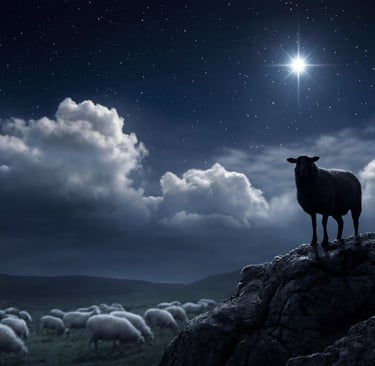
The Dignity of the Black Sheep: Beyond the Fence of Denial
Most people spend their lives terrified of becoming the "Black Sheep" of the family or the group. They view it as a mark of shame or a lonely exile. But what if being the Black Sheep is actually the most freeing experience a human being can have?
To become the Black Sheep, one must first endure a Great Weathering. It begins with the friction of not bending—of refusing to play by the usual rules. This makes others uncomfortable because, deep down, they recognize the freedom you have that they have traded for safety.
The root of this journey is found in a specific space: the fence between denial and acceptance. Most people live in denial to keep the peace. But if you are naturally a Black Sheep, do not resist it. Do not grieve it. The freedom you have been searching for is waiting just on the other side of that fence. Once you stop trying to climb back over to join the herd, you finally become who you are.
Being the Black Sheep is often the first symptom of awakening. You begin to see through the "games" people play to maintain their identities. You realize that most people are building their sense of self through their relationships, their trauma, or their labels.
Once you reach this point, sharing a casual laugh or a superficial moment is no longer enough. You find yourself unable to participate in the "old game." You are no longer looking for a personality; you are looking for an entity. You seek someone who knows they are already whole—someone who doesn't need to use you to avoid themselves.
The Narrowing of the Path
There is a price for this clarity. As you awaken, your field of choices narrows considerably. Where once there were many possibilities for love and friendship, now there are very few. You can no longer fall in love merely with a smile, or charm. You need them to be awake. You need them to see what you see. Spiritually awakened people are often alone, not because they are incapable of love, but because they have outgrown the games that pass for love in this sleeping world.
At the beginning of this awakening, you might wonder: Did I make a mistake? Should I have stayed in the comfortable avoid with the others?
You are correct to feel the weight of this cost. It cost you the ability to be satisfied with an illusion. It cost you the "comfort" of not knowing. It cost you the ability to use another person as a distraction from yourself.
There is a tremendous dignity in this specific kind of aloneness. Standing in clarity—even if it means standing alone—is infinitely better than "kneeling in an illusion" just to have company. You are not waiting to be completed anymore. You know you are complete. You no longer need the approval of the group to validate your existence. You are waiting for someone who speaks your language—someone who has observed life, dealt with its fires, and arrived at a similar state of being.
The Law of the Narrow Path
There is a strange paradox in this journey. At first, as you stop playing the games and refuse to settle for illusions, your world seems to shrink. Your social circle thins, and the dating pool feels like a desert. You might feel as though you are losing everything. But this narrowing is not a loss; it is an alignment. When you stop pouring your energy into "many" false possibilities, you stop the leakage of your spirit. You become a focused beam of light. Once you align with your truth and accept the dignity of your aloneness, the universe responds differently. The "narrowed possibilities" begin to flow toward you from entirely unexpected sources.
It is no longer about you searching; it is about you radiating. Because you are no longer playing a role, you become a "signal" that can finally be heard by others who are also awake. You start to attract people, opportunities, and connections that speak your specific language. These aren't the forced connections of the "old game"—they are effortless. They don't require you to bend, hide, or explain yourself. They flow to you because you have finally stopped standing in your own way.
The path is narrow, yes—but it is paved with truth. And on this path, you only need to meet one person who truly sees you to realize that a thousand shallow connections weren't worth a single moment of this reality.
Kneeling in Illusion vs. Standing in Truth: The Path of the Awakened Outcast

Comments
Shape Your Vision, Free Your Soul
Unleash your artistic potential with us today.
Contact
NilayCarlson@GaiaArtHub.com
+1-604-989-9896
© 2024. All rights reserved.
© 2026 GAIA. All rights reserved. GAIA is a brand owned and operated by Gaia Art Hub, British Columbia.
Comments